Forestry Mulching Costs, Timeframes & What to Expect
Thinking about turning overgrown acres into pasture? Learn how forestry mulching works, what it costs, and how long it takes so you can plan your project with confidence.
Forestry Mulching 101: What We Told a Customer Asking About New Pasture
We recently got a call from a customer — let’s call her Katie — who was looking at a couple of different properties here in southwest Missouri. Both had a mix of blackberries, briars, brush, and young cedars. Her big question was simple:
“What is forestry mulching exactly, how much does it cost, and how long does it take to turn this into usable pasture?”
We walked Katie through the process step by step so she could decide whether pasture clearing would be a “do it now” project or a longer-term plan. If you’re staring at overgrown acreage and wondering the same things, here’s the same breakdown we gave her.
What Forestry Mulching Actually Does to Your Land
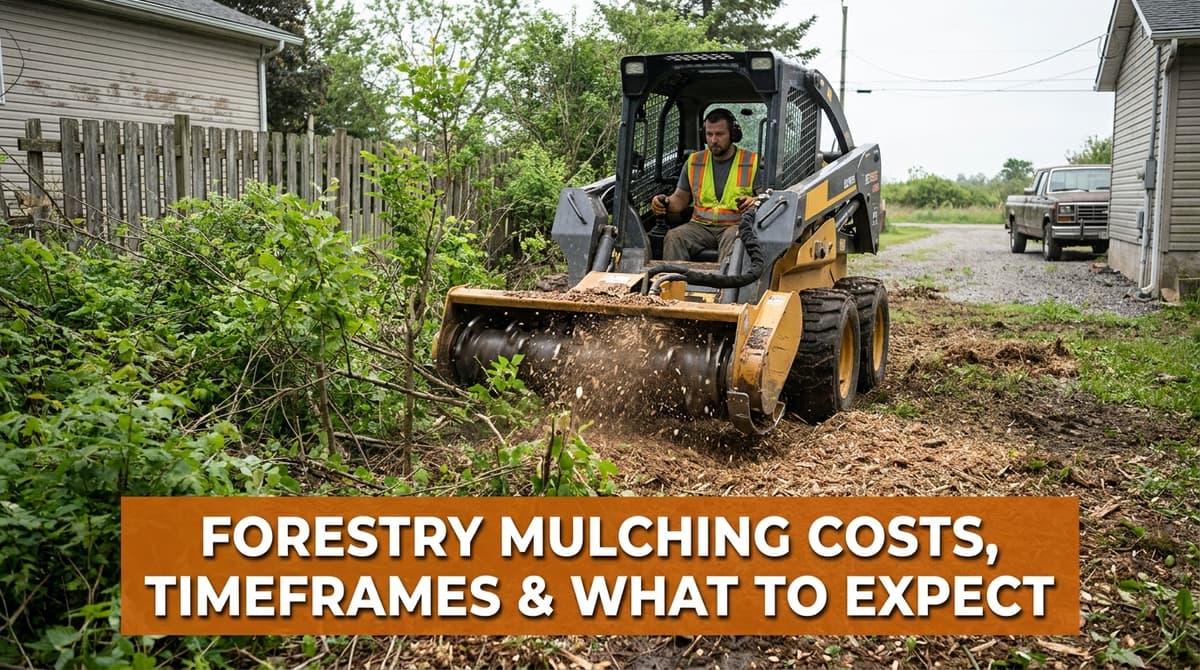
Forestry mulching is a land-clearing method where we use a machine with a specialized mulching head to grind brush, saplings, and small trees into wood chips right where they stand.
On a typical pasture project, we will:
- Take down everything under about 6–8 inches in diameter (depending on your goals and the site)
- Leave your key canopy trees for shade and long-term value
- Turn thick underbrush into a layer of mulch that looks like coarse “garden bed” mulch spread across the ground
That’s exactly what we told Katie: after we run through, the blackberry thickets, briars, and small cedars would be on the ground as mulch, and the larger shade trees she wanted to keep for pasture would still be standing.
Skid Steer vs. Dedicated Mulcher: What We Run and Why
Katie asked a smart question: “Are you using a skid steer with a mulcher head, or a dedicated forestry mulcher?” We get that one a lot.
Here’s how we explained it.
Skid Steer with Forestry Head
On most pasture-conversion jobs, we run skid steers with forestry mulching heads. That setup has a couple of big advantages:
- Flexibility: We can switch between the mulching head and a grapple to move material.
- Clean-up ability: After mulching, there are often rotten logs or chunks that won’t mulch well. With the grapple, we can pull those out and stack them in burn piles where it makes sense for you.
- Access: Skid steers can work in tighter or more awkward areas than some larger dedicated machines.
Dedicated Mulching Machines
Dedicated forestry mulchers are big, powerful, and fast — but they have tradeoffs:
- They’re great at pure mulching in large, consistent tracts.
- They typically can’t grapple and move debris, so you’re often left with more chunks and downed material scattered across the ground.
Because most of our customers, like Katie, want to end up with usable pasture, not just “chewed-up woods,” we lean toward the skid steer + forestry head + grapple combo. It lets us mulch and then tidy up so you can actually drive, fence, and mow the area later.
How Forestry Mulching Is Priced: Per Acre and What Affects the Rate
When Katie asked, “Do you charge by the acre, day, or hour?” we told her what we’ll tell you: we typically price per acre for pasture-type projects. Around here, that often falls in the ballpark of about $2,000 per acre for average conditions — but there are a lot of moving parts that can shift that number up or down.
Main Factors That Affect Mulching Cost
- Terrain: Steep, rough, or rocky ground slows us down. Katie’s plan was to leave the really steep areas wooded, which helps keep costs in line.
- Brush and tree density: A field with scattered cedars and briars costs less per acre than solid young woods.
- Tree size: Lots of stems under 8 inches are perfect for mulching. Once we get into larger-diameter trees, that’s more chainsaw/sawmill territory than mulcher territory.
- Access: If we can get the machines in easily and don’t have to do weird backtracking, we’re more efficient.
- Diesel costs: Katie caught us on a week when diesel had just jumped, and we were very honest with her — fuel price swings do affect the per-acre rate.
- Total acreage: The more acres we can do in one mobilization, the better the per-acre pricing usually gets because we’re not hauling equipment in and out multiple times.
That’s why we like to talk through your specific property before throwing out anything more than a rough ballpark.
How Long Does It Take to Clear an Acre?
For the type of ground Katie described — some slope, but not the really steep spots, and mostly brush, briars, and small cedars — we told her she could expect around:
- About 1 to 1.5 days per acre under average conditions
Some things that can speed it up or slow it down:
- Light underbrush and scattered saplings: Faster.
- Thick young forest or heavy cedar stands: Slower.
- Stop-and-go working conditions: If we’re weaving around structures, fences, or marked “do not touch” trees, that adds time.
On a multi-acre job with similar conditions across the whole tract, we can often get into a rhythm and be more efficient per acre than on tiny, broken-up patches.
What Happens to the Underbrush and Small Trees?
A big concern for Katie was cleaning up the underbrush so they could safely drop some of the bigger trees themselves with their small sawmill. Forestry mulching is perfect for that.
Here’s what you can expect on the ground when we’re done:
- Brush, briars, and saplings: Ground into mulch and left in place.
- Small cedars and junk trees: Mulched down to stumps that are typically just a few inches tall or less.
- Rotten logs and big chunks: We’ll pull those out with the grapple and stack them where you want burn or brush piles.
- Canopy trees you’ve chosen to keep: Still standing, usually with clear access around them.
The result is a much more open, park-like look compared to the wall of brush you started with, and it’s far easier and safer for you to work in later with a chainsaw or tractor.
Using Forestry Mulching to Create Pasture Long-Term
Like many folks moving onto acreage, Katie was thinking in phases: clear enough now to gain some usable pasture, then keep improving over time. Forestry mulching works well with that kind of long-term plan.
How Mulching Supports a Pasture Conversion Plan
- Preserves your best trees: We can selectively leave big oaks, walnuts, or other shade trees for livestock while removing the junk underneath.
- Improves access immediately: Once mulched, you can walk, drive a UTV, plan fence lines, and mark future building or paddock areas.
- Preps the soil surface: The mulch layer helps hold moisture and reduce erosion while you decide on grass seed, fencing, and grazing layout.
- Works in stages: You don’t have to clear everything in one shot. Many landowners start with the most usable acres and expand as budget and time allow.
Next Steps If You’re Considering Forestry Mulching
If you’re in a situation like Katie’s — comparing properties or trying to decide how much to tackle now versus later — here are a few practical tips:
- Walk the property with a map app open and mark the areas you’d want cleared first.
- Decide which large trees are “keepers” for shade and long-term value.
- Note the steep or rocky areas you’re comfortable leaving wooded.
- Have a rough acre count ready so we can talk realistic budgets and timelines.
From there, we’re happy to come out, walk it with you, and mark out specific mulching areas so you know exactly what to expect in terms of cost, timeframe, and how that land will look when we’re done.
If you’re ready to turn overgrown acres into usable pasture while keeping the character and shade of your best trees, forestry mulching is often the most efficient way to get there.